
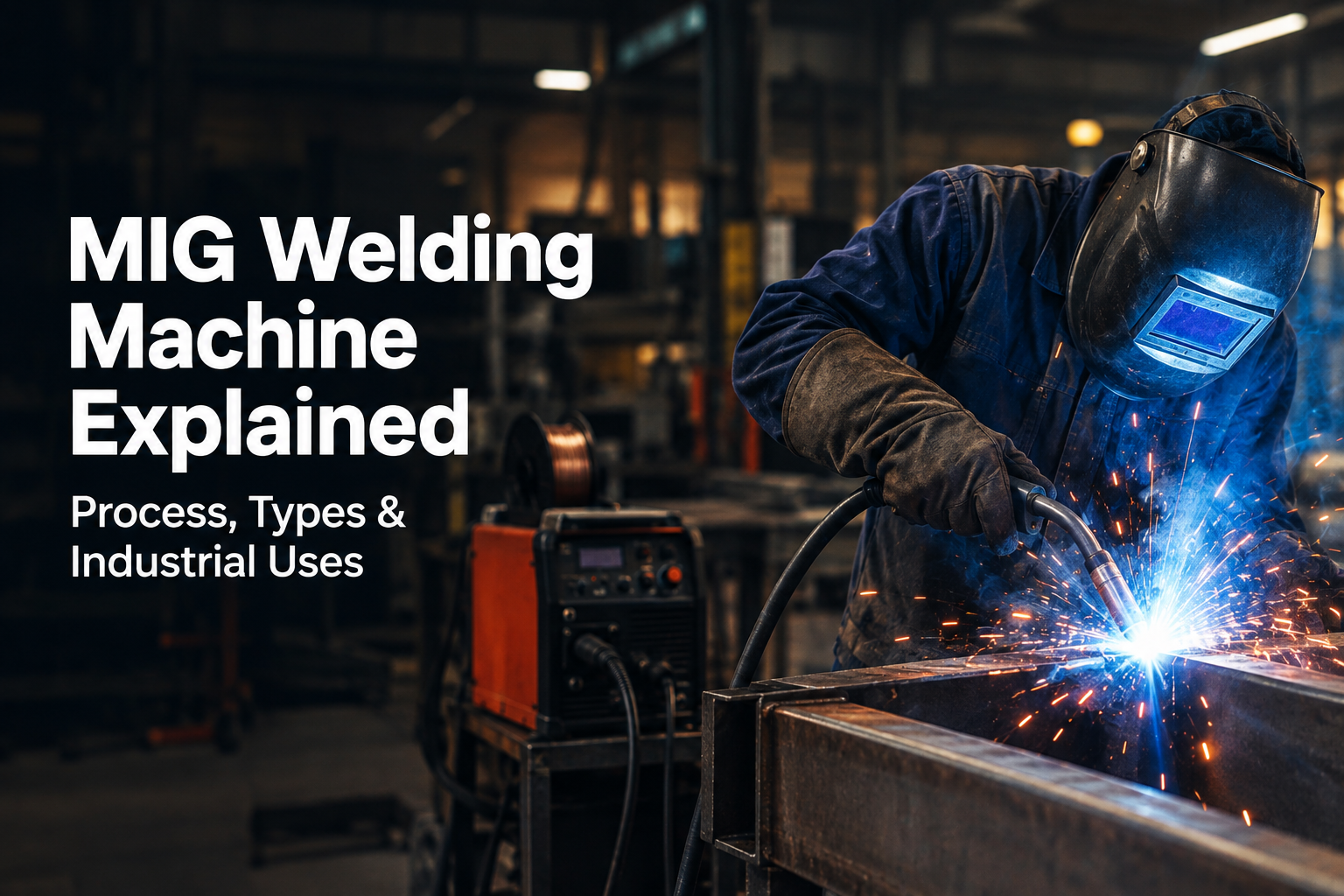
MIG Welding Machine Explained: Process, Types & Industrial Uses
You may have thought about MIG welding machines versus TIG and stick welding machines and wondered what to do — which is why you are here. Most buying guides end with “MIG is easier to learn,” which is correct, but not of much value when you’re trying to set voltage, switch from single-phase to three-phase power, or understand why your last weld had spatter all over it. This guide explains everything: how it works, the difference between a transformer machine and an inverter, the exact settings according to material thickness, the safety measures you must take, and the usual defects and how to fix them on a shop floor.
What is a MIG welding machine?
MIG is also known as Gas Metal Arc Welding (GMAW). A MIG welding machine pushes a continuous solid wire electrode through a welding gun, and as the electric arc melts the wire and the base metal together, a shielding gas (typically argon, CO2, or a mixture of both) protects the molten weld pool from oxygen and contamination from the surrounding air. It’s also known as a metal inert gas welding machine or a MIG wire welding machine.
MIG is not as precise as Shielded Metal Arc Welding (stick) or Tungsten Inert Gas welding (TIG), but it is faster and easier to use, and is used more often in production welding, fabrication shops, and automotive repair. When it comes to precision, aesthetics, or thin work, TIG is the better choice. For outdoor, rustic, or dirty material, stick is the only way to go, as it requires no gas shielding at all.
| Feature | MIG (GMAW) | TIG (GTAW) | Stick (SMAW) |
|---|---|---|---|
| Location of learning | Within the classroom | Outdoors or in the community | Within the classroom and outdoors or in the community |
| Reliability | Good, less susceptible to breakage | Good, minimal breakage | Good, breakable at times |
| Shielding | External gas required | External gas required | Flux coating, no gas |
| Best for | Production or fabrication task, auto body | Thin metal, precision or aesthetics | Outdoor, dirty, or rusty material |
| Portability | Moderate (cylinder + machine) | Moderate to low | High |
| Characteristic materials | Mild steel, stainless, aluminium | Aluminium, stainless, thin steel | Structural steel, pipe, repair work |
How a MIG welding machine operates
A MIG welding machine is actually four systems in one:
- Power source — provides the constant voltage current which maintains the arc.
- Wire feeder — pushes the solid wire electrode through the gun at a set speed, usually measured in inches per minute (IPM) or metres per minute.
- Welding gun and contact tip — conducts the wire and current to the joint; the contact tip conducts current into the wire just before it leaves the nozzle.
- Shielding gas supply — a cylinder is connected to the nozzle to protect the arc, and a ground clamp completes the circuit back to the machine.
A smaller feeder unit, known as a spool gun, is also sometimes fitted to certain machines, and is mainly used for aluminium wire — which is softer than standard wire — so that it does not buckle when being pushed through a long cable.
MIG welding vs Flux-Cored Arc Welding (FCAW)
It is common to confuse MIG and flux-cored arc welding, because both use the same type of gun, and some MIG machines can run either process. The difference is in the wire itself. MIG is the solid-wire process and requires external shielding gas. With flux-cored wire, the flux compound inside the wire produces its own shielding gas as it melts, so little or no external gas is needed — useful outdoors or on site, where wind would blow the shielding gas away from a standard MIG setup. A machine advertised as “MIG/flux-core capable” is not a two-wire machine — it’s a single wire-feed machine that can run either wire type.
The best materials and applications for MIG welding
MIG is capable of welding a broad spectrum of materials using the appropriate wire/gas combination:
- Mild and carbon steel (most popular application), usually run under CO2 or argon-CO2.
- Stainless steel — requires a tri-mix or argon-rich gas mixture to prevent carbide precipitation at the weld.
- Aluminium — pure argon shielding is required, and for thinner gauges a spool gun is essential to avoid kinking the soft wire.
Due to the speed of learning and its ability to run quickly, MIG is used throughout auto body repair, structural fabrication, MSME manufacturing workshops, sheet metal work, and general maintenance welding. When the settings are properly matched, welding without burn-through is possible on sheet metal as thin as approximately 1 mm.
Types of MIG welding machines
There are two main types of MIG machines, based on how they produce welding current.
Transformer-type machines reduce the mains voltage using a large copper transformer. These are more basic, more durable, and typically less expensive upfront, but they are also heavier and tend to be less accurate for fine current adjustments.
Inverter-based machines use high-frequency switching electronics (often IGBT-based) to produce welding current. They are lighter, more portable, allow for finer control of voltage and amperage, and generally run more efficiently — though they usually carry a higher initial price tag.
Duty cycle and power supply
There are two specifications that determine whether a machine will meet your workload, and both are overlooked in most machine-buying guides.
Duty cycle is the percentage of time a particular machine can weld at its rated output within a 10-minute period before it has to cool down. A 200A machine with a 60% duty cycle can operate at 200A for 6 minutes out of every 10; push it beyond that, and thermal protection will shut it off. A higher duty cycle and amperage on the same machine generally means a heavier, more capable machine — more important for production-line welding than for occasional repair jobs.
Whether a machine can even be plugged in at your site depends on single-phase vs three-phase power. Single-phase machines run off a normal shop or domestic supply and suit small workshops and jobs under 100 amps. Three-phase machines require special industrial wiring and deliver a more consistent, higher-amperage output, making them better suited to heavy fabrication and continuous production welding. The most common mismatch in MIG welding machine shopping is checking power availability at your workshop only after the machine arrives — confirm this first when shortlisting a machine.
MIG welding settings: voltage, wire feed speed and gas flow
The following ranges are a good starting point and should be fine-tuned by testing welds on scrap before starting work on the actual job, based on wire diameter, material, and the type of shielding gas used.
| Thickness of material (mm) | Voltage (V) | Wire feed speed (IPM) | Gas flow (L/min) | Notes |
|---|---|---|---|---|
| Thin sheet (1 mm to 2 mm) | 15–18 | 90–150 | 8–10 | Higher risk of burn-through; steady travel speed |
| Medium (3 mm to 6 mm) | 19–24 | 150–300 | 10–15 | Most common structural and fabrication range |
| Thick section (6 mm+) | 24–28+ | 300–450 | 15–20 | Multiple passes usually required |
| Aluminium (spool gun) | 17–22 | 200–350 | 15–20 | Pure argon only — push, not pull |
Weld a test bead on a scrap piece of the same thickness and material as the job before you begin. There are differences in settings between machine brands even at the same displayed wire feed speed and voltage.
MIG welding safety basics
Safety information is no filler material in a welding guide — it’s how injuries are prevented.
Eye and face protection. The MIG arc produces extremely high levels of UV and infrared radiation, which can cause arc eye (photokeratitis) within seconds of direct exposure. Welding helmets (shade 10–13 for MIG) and safety glasses (worn under the helmet for grinding and clean-up) are required.
Fume safety and ventilation. Metal fume is generated during MIG welding, and its composition depends on the base metal and coating — galvanized steel in particular emits zinc oxide fume, which can lead to metal fume fever. Weld in a well-ventilated area or use local exhaust extraction systems, and do not weld on a coated or painted metal surface unless it has been ground back to bare metal at the weld joint.
Fire and electrical hazards. Remove any combustibles from the work area, keep a fire extinguisher on hand, and check the cables and ground clamp for damage before starting. Never weld with a damaged gun, damaged lead insulation, or in a wet work area.
Common MIG welding problems and how to fix them
| Defect | Likely cause | Fix |
|---|---|---|
| Too much spatter | Open arc voltage too high, wire feed speed not matched to voltage, or dirty base metal | Reduce voltage slightly, match wire feed speed to voltage, and clean the base metal before welding |
| Burn-through | Voltage or heat input too high for material thickness | Reduce voltage, increase travel speed, or use a smaller wire diameter |
| Small holes in the weld (porosity) | Insufficient or contaminated shielding gas, wind drafts, or oily/rusty metal | Check gas flow and cylinder level, protect the work area from wind, clean the joint |
| Undercut (groove along the side of the weld) | Travel speed too rapid or voltage too high for the joint angle | Slow travel speed, reduce voltage, and adjust the gun angle |
| Weak or cold weld (lack of fusion) | Voltage or amperage too low for the thickness of material | Raise voltage and wire feed rate, lower travel speed slightly |
The benefits and disadvantages of MIG welding
Advantages
- The continuous wire feed does not require the operator to change electrodes like stick welding does, delivering long continuous welds with less post-weld cleanup.
- Quick to learn compared to TIG, making it a practical option for in-house training.
- Makes sound welds in steel, stainless steel, and aluminium using the appropriate wire and gas.
- Produces a smoother weld bead and less slag than stick welding.
Limitations
- Requires external shielding gas, making it less practical outside a controlled environment or in windy conditions unless flux-cored wire is used instead.
- Not as accurate as TIG for thin or cosmetic applications.
- Needs a gas cylinder and regulator, adding to equipment and running cost.
- More sensitive to base-metal cleanliness than stick welding.
How to select the appropriate MIG welding machine
Choose the machine for the job, not the highest amperage number on the box:
- Amperage and duty cycle based on what you actually need — a production line running back-to-back welds needs a very different duty cycle than occasional repair work.
- Single-phase or three-phase power supply at your site — confirm this before shortlisting, not after delivery.
- Portability — inverter machines are ideal for site work and multiple locations, while transformer machines suit a fixed workshop bay.
- BIS/ISI certification and after-sales service — for procurement or export documentation, confirm the applicable ISI certificate directly with your supplier. For MIG/inverter welding machines, verify the specific IS/BIS standard number that applies, as this is not the same as the IS 2641 standard used for electrode holders.
- Minimum order quantity and warranty terms — relevant for workshops and procurement teams ordering more than one unit.
If you’re still deciding between MIG, TIG, and stick welding for your workshop, our detailed types of welding machines guide will help you make the call. Check out our welding cables and electrode holders range for items that complement a MIG system.
Excellent Enterprises, a B2B industrial supplier, offers a wide range of welding machines, cables, and electrical accessories for contractors, fabrication shops, and MSME workshops in India, with a low MOQ of 20 units — including the ARC-400 IGBT welding machine, a good option for shops testing an inverter-based welding machine for the first time.
Conclusion
The popularity of a MIG welding machine comes from how easy it is to use, how well it performs across a number of different welds on steel, stainless steel, and aluminium, and how much it depends on the settings, duty cycle matching, and safety precautions used alongside it. Get the voltage and wire feed speed right for the material thickness, respect the duty cycle rating for the job at hand, and treat PPE and ventilation as part of the job — not an afterthought.
Ready to spec out your workshop’s MIG welding equipment? Contact our team for a quote tailored to your amperage, power supply, and order quantity requirements.